Thursday, September 20, 2012


REFLECTION ON ISSUES DISCUSSED AT THE (second)MEETING OF YOUNG PACIFIC ISLAND YOUTH LEADERS AND SUPPORTING MINISTERS.

14th September 2012.

Venue - Parnell Presbyterian Church and office of the Pasifika Misionare.


Fakalofa atu, Taloha ni, Fefe hake, Talofa, Kia Orana, O Blimey

A quick response regarding yesterday's meeting.(14th Sept 2012)

Thank you for those who attended and those with apologies about yesterdays meeting.

What a blessing to be lead in devotion by Tani and to reflect about the creating nature of God. It highlighted the abilities of our God to continue with the maintenance of his handy work, the life that comes from God and the need for Pacific people to take heed to what this week's psalm share.

There was much reflection on the importance of the group in its focus, but most importantly its neutrality among the different configuration of the PCANZ  church family in regards to PAcific youth and young people.
This group that has gathered to provide the voices of young Pacific members from the different parts of youth ministries in the PCANZ. The gathered group needed to continue its work with a clear mandate of drawing from all of the youth leaders and young adults of the Pacific membership of the whole church.
The MISSION of God is the focus of this group. So when we gather, it is with the aim of representing ALL those with Presbytery affiliation as well as the ethnic specific & ESG members.

Meauli's message at the regional forum hosted by the Northern Presbyterylast Friday was well received. He spoke of the Grace of God that had manifested through the lives of the pioneering Pacific Island migrants (our parents and grand parents). They brought their faith and established themselves in churches that we have inherited.

Meauli stressed the importance of Christ like leaders, who are called to inspire young people into fostering personal relationship with Christ Jesus. In order to achive this, we, as young leaders of the church must be inspired ourselves.


  The Rev Kaio and I were there as members of the Northern Presbytery Council, in support of the forum that was aimed at naming for Presbytery what the direction of youth ministry need to be.


The turnout of youth leaders was quite impressive, as they represented congregations within the Presbytery. A further joy was to see about 80% of young people there were from Pacific congregations that are not affiliated to the Pacific Synod.


The absence of Pacific Synod and Asian youth and young leaders must be seen as an intentional strategy towards ministries that employ approaches that are a mixture of Christ and culture traditions and cultural expressions.

The PI Synod do have youth ministries within each Parish, and each Fonos (National Meetings of Constituents), as are Asians in the council of Asian ministries.


The Pacific Island Synod youth and young people mission and ministries, do operate quite independently within their own Fonos, running regular programs and mission training workshops. The Fono Samoa tupulaga/autalavou also gather in regions (matagaluega) and do organise these regional services three or four times a year. The Cook Island Uapou Fellowship Youth movement (Mapu) extended themselves in 2011 when they hosted and managed the National Uapou Fellowship which was their national gathering with professionalism and spiritually filled.

What has been a downside of such a set up is a tendencies of each group only doing mission and ministry within their own fono. This will be something that this group can bring to its work; which is to influence Presbytery, PI Synod and Asian Ministries to intentional integrated ministries with other youth groups within the Church.


This will mandate such a interconnectedness to be one of the aims of each youth leader, Minister and Presbytery bodies, so that not only do PI Synod youth interact with others from various fonos, but also be open to work with groups outside its Synod families. Likewise, youth in the regional Presbytery network are also called to interact with the PI Synod, Asian and national (PYM) young people.

The meeting saw the need for plans to be more forward looking with an imagination of what the face of Pacific Youth Ministry in the next five to ten years.

This does require the youth and young people who are involved in ministries currently to be listened to. The face of ministry in the future may not resemble what we do consider as ministry today, however it is important for the Church in its discernment and continued stewardship to listen and be guided by the vision of God manifested in and through our young people today.

 
The strength of this Pacific Island Leadership group is with the influence they collectively bring to churches they are involved with, and in the role of the Pasifika Misionare office to influence decision makers within both national and regional level of youth mission and ministry, that may allow the resourcing and the development of such (new) expressions.


The Pasifika Misionare in his role plan to provide leadership training forums for youth leaders, in areas of:


·       personal development,

·                  how to develop the young people that you have to be spiritual leaders

·                  call to ministry- how to listen to God, what is it that God plan for your          life.

·                  evangelism - learn to read the people you plan to reach in bringing to

·                   Jesus.

·                  How can you best and effectively communicate by sharing the            love of Jesus into their lives.

·       inter-generational workshop between migrant parents and NZ born children,

·       Culture and Gospel,  How does Culture relate to Gospel. What are the aspects     of culture that require close attention in terms of youth ministry.

·       orientation into understanding about the Presbyterian Church, its mission, ministries, structures and governance. To become participating members in a   local congregation, youth leaders need to know, what processes are in          place that need to be adhered to and the reasons why they are there.


Dates and venues of these training session will be made available before the end of the month.


There are also questions regarding the youth and young people that are not currently in churches that we need to address. (refer to statistics of Pacific members in Aotearoa NZ provided by Statistics NZ the Pasifika Misionare provided earlier)

·       How can we evangelise to the masses. As a mission church, can we begin the process of thinking of the Church in terms of the universality of God. What can we do to reshape our thinking into an inclusive and unconditional family of God. {He imparts numerous advantages, blessings, and tokens of His kindness on both the righteous and the unrighteous (Matt. 5:45). All of those things are the result of common grace, God’s goodness to mankind in general}

·       If youth and young people do not share the joy of expressing their faith in Jesus as we do by mission and ministries within the designated boundaries of Church- Sunday Worship, can they still be sons and daughters of God. Could they be his sheep that are not of this sheep pen as stated in John 10:16? yet they are considered as belonging to other sheep pens that Jesus claimed to be his.

·       Many of Pacific youth and young people still belong to extended families and still gather with special church services and activities(funeral services, weddings, baptisms, special birthdays).

·        Many of them continue to contribute to the life of the church through donations passed on by their parents and relatives, yet they rarely attend Sunday Services.

·       We see so many in the sporting and musical events acknowledge God in prayer, and openly offering God their praise for their achievements.


These topics of discussion will be important in sessions of evangelism and ensuring the presence of Jesus Christ is felt and enjoyed in all corners of communities. These are however not questions that requires discussion only in terms of youth and young adult mission, they are BIG QUESTIONS  for each minister to consider. Presbyteries, congregations, parish councils, men and women groups, elders sessions, deacons courts and managers courts. WE ALL NEED TO TAKE TIME AND CONSIDER THIS OUTREACH actions and where we stand in terms of redefining policies, processes, and church as we know it, so that Jesus' love is embracing all of his children.


DATES and VENUES of the latter questions will be considered with advise from the various groups that are involved in decision making as well as those with influence in feeding lifeline of mission to policy makers.


(My reflection on mission and ministries within Pacific Youth as I gather information during my work among Pacific Island Youth and Young Adults. Feel free to add to these, members of the young Pacific Island youth gathered as we gather information about the needs, the approaches taken, and reflections on God's hand your own lives and ministries you are leading.)


Rev Don Ikitoelagi

(Pasifika Misionare)


Grace of God imge.

Monday, September 3, 2012

PASIFIKA MISIONARE

Second meeting of Pacific Island Youth and Young Adults in the PCANZ.
URGENT NOTICE!!!!!
Change of meeting DATE:

      28TH SEPTEMBER 2012        venue: Knox Parnell.   4b Birdwood Crescent Parnell.
TIME 9.30am  to 2.30pm

PASIFIKA YOUNG LEADERS GATHERING
 
How can we live out the Gospel story of Jesus Christ in AOTEAROA NZ, as Pacific Young People.
 
Leaders group will engage in prayerful consideration and meditation about the purpose of all these gathering that we have in the Church. How can these be managed so that they work in with ech other, rather than polarising young people.
 
  • Regional gathering (inclusive of all youth groups from an ecumenical family of churches around the Region.)
  • Ethnic gatherings: Mapu (Cook Island): Kautalavou(Tuvalu/Tokelau);Tupulaga/Autalavou(Samoa);Niue National Youth (Fono Motu); English Speaking Group.
 
WORSHIP: if this is the call that we are invited to take up, WORSHIP OUR LORD AND SAVIOUR, then we do need to be gathered in his name. That we are call to come with our diversity, and seek ways found only at the base of the Cross, of being United in Him.
 
Its wonderful to immerse ourselves in the church traditions and cultures that have made us who we are, as long as we do this as well as reaching out to others in the community to share in this glorious pentecost experience. Jesus commission us to go forth and make disciples of all nations baptising them in the name of the FATHER SON AND HOLY SPIRIT.
 
We are called to PREACH, we are also called to TEACH, and we are call to share attributes that Christ has, in loving, kindness, generous, concerned of our wellbeing, search of the lost, and  in ways that we live our own lives.
 
It was obvious from our first meeting that there are some in our lineup of young leaders that have the passion to preach the word of God, others are great strategists who will help us plan well, others are super great musicians who could lead the upskilling of some of our musicians in Parish youth groups. Others obviously have the wisdom and abilities to read church structures and governance and advise young people of best practice at local, regional and national level.
 
There will no doubt be others who are great organizers and managers of events that will work towards community gatherings and community worship.
 
This second meeting is to begin planning on ways that we can manage this journey.
 
I have made suggestion on what could appear in the agenda in the blogg of the first meeting of leaders. But please come prepared to share what is God saying to you and if possible offer yourselves to head specific tasks that may be agreed as ways forward.
 
 
The next meeting will be on the 14th  (Friday) September 2012 or 22nd (Saturday) September 2012.
 
Please indicate the date that you would prefer out of the two, and we will see which date to run with.
 
VENUE WILL BE at Knox Parnell
Lunch will be provided.
 
Opening devotion will be conducted by Nate, Tani and Gary.
 
PLEASE BRING DETAILS OF YOUR PARISH ACTIVITIES IN REGARDS TO YOUTH SERVICE< WORSKSHOP< OUTING<etc so we can have a event caledar  for youth mission and ministries in Auckland.
 
We will take time to map out matters of mission, ministries, training, theology, sense of call, identity issues, intergenerational issues........
 
If there are issues that you would like to appear in the AGENDA this time, please indicate early and so we either include it for this meeting or note it for the next.
 
Closing devotion will be conducted by Mose, Helena and Meauli.
 
May I ask someone to be a note taker for the meeting.


Rev Don Ikitoelagi


Tuesday, August 28, 2012

 TONGAN PRESBYTERIAN CONGREGATION

A Tongan Presbyterian Congregation is something NEW for us in the Presbyterian church.
One has been in the making for more than 10 years.

The Greenlane Presbyterian Church has nurtured the development of a Tongan community in their congregation for many years, and this I believe has given birth to something new. (I have been proved this additional information about the roup being recognized as a "fellowship" rather than a congregation-The Tongan Fellowship was established on
18th December 1988 by Tauni Uasike, under Rev Len Currie's ministry.
..)
Tani and the leaders of the Tongan community will continue to work with the Council to establish a structure that can meet the growing need of the Tongan young families, youth and infants.

Multicultural model of Church will depend on how the Council would see the future development of the members. As long as one that nurtures the fakaTonga ways and allows Tongan language, Church culture, aspects of their Methodist upbringing such as the recognition of the Setuata (stewart a Methodist term relating to a specific role).


Many of the migrant members of the congregation have Methodist Church (Wesleyan) affiliations. If they were to travel back to Tonga, they no doubt will resume their place in the home Church where they were born and raised to. Even if this is the reality of home church connection, we need to recognise that they are Presbyterian members,that would like to also include in their worship and their mission and ministries, aspect of their expressions that ought to be Tongan.

For the members that are NZ born, second generation; their needs may be slightly different to those of their parents, however, their family traditions, their respect for the parents and the elders of the community exist and continue to be enforced while they are gathered with the migrant parents.

There will be continued work in managing this inter-generational issue. This is an aspect of training that I plan to organise and run as a necessary part of Cross cultural and inter-generational approach to mission and ministry.

I attended the worship service of the Tongan congregation in the Greenlane Presbyterian Church today and presided over Holy communion, unfortunately I received the Tongan version of the Communion liturgy. I found the contemporary feel to their worship. The modern set up of the Church sanctuary helped this in some way, with Tani offering leading in a mix of both contemporary and elements of Tongan Methodist ways, as well as a bilingual approach to all espect of the Service.

The majority of the service was conducted in Tongan, however for the benefit of non Tongan speakers, Tani busied herself typing directly onto power-point translation, saving time and improving communication which I found refreshing as well as it being innovative.
During the time of my sharing, she showed great skills in translating my English to Tongan, and when I spoke in Niuean (Many similarities) she was also able to translate Niuean to Tongan.

The Communion I conducted in English, and in some regards used aspects of the method they were accustomed with during the distribution of the elements.The Spirit of God I did feel strongly was with us as we offered an open invitation to all, to come forward and receive the Body and Blood of Christ Jesus.

I do hope to approach the local minister of the other Presbyterian Churches that have Tongan members at the PT C hevalier Presbyterian of the possibility of discussing some joint events. with the Greenlane Presbyterian Tongan community (fellowship).

Tani has also established connection with Tongan students studying at the Laydlaw College in Lincoln Rd Henderson. She reported this to be welcomed by the College and has linked in to her involvement with the c ollege where she gained her undergraduate degree.

Malo Aupito.

May the love of God continue to be with you our Tongan brothers and sisters until we meet again.


AMEN.


REGIONAL GATHERING (Matagaluega) OF YOUTH (Tupulaga/Autalavou) of the Fono Samoa a constituent member of the PI Synod.

TAMAKI PIC
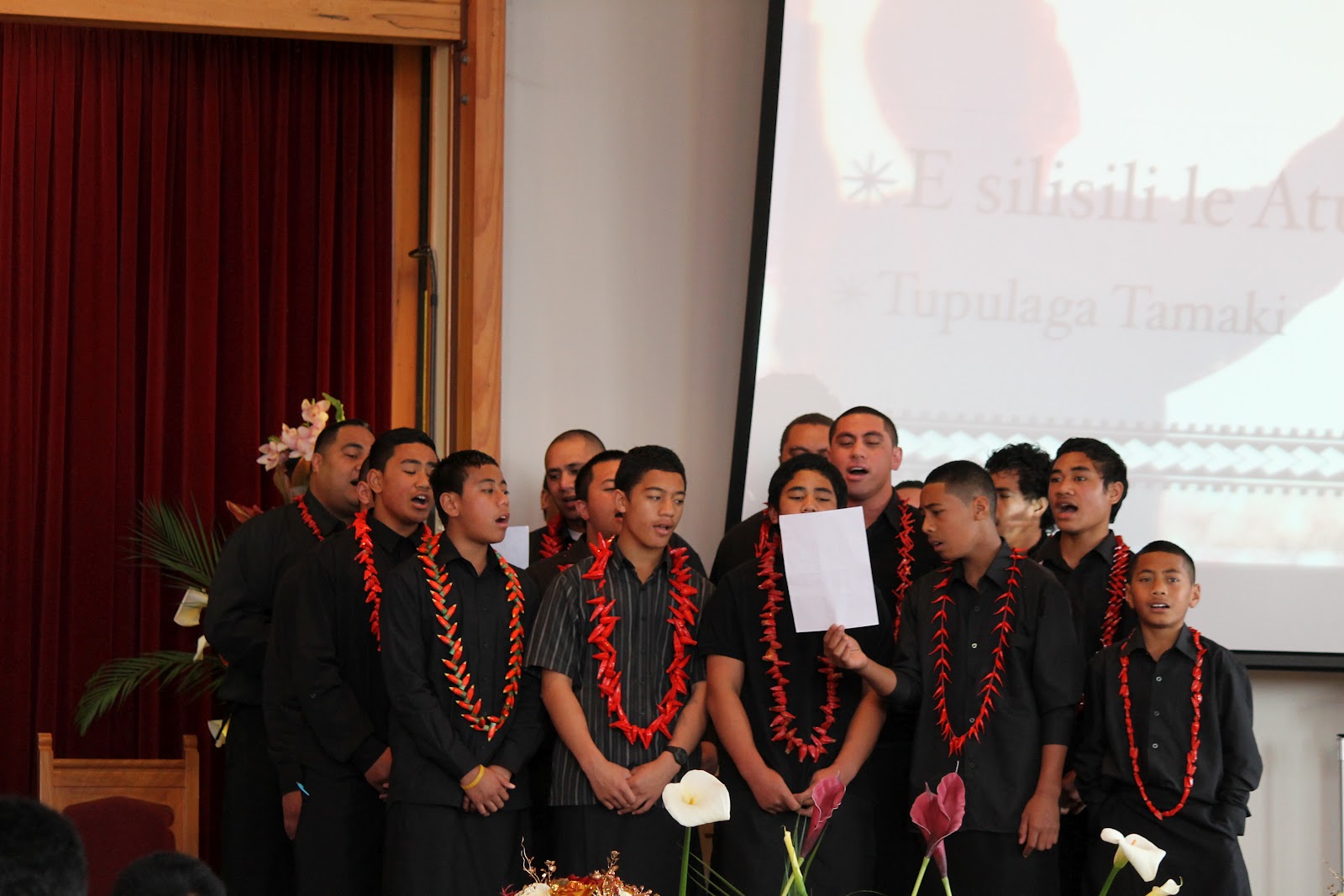
The Rev Leiite Setefano invited me to their regular matagaluega service on the 5th August 2012. The service was led by the toeiina Rev Leiite Setefano, with participation from the youth (tupulaga)  of the three congregation that makes up the region (matagaluega). The choirs of the three congregations offered hymns to the glory of God with a touch of contemporary beat interwoven with the harmony one can only find in the pacific. The tupulaga from Pamure did a drama that highlights the manner in which the Gospel preached can be ignored as irrelevant to the lives of youth and young people today.  The Glory of God was portrayed in many contemporary ways that was well intended for the youth the young as well as the parent supporters.

A comment on the nature of the Autalavou and the new initiative of the Fono Samoa to be more intentional on developing the younger youth, the tupulaga while still ensuring that the groups that were well served by the Autalavou which was the 20years and older clearly those young people who no longer relate to being youth. It appears that various approached has been developed by each of the congregations (aulotu). Some are assuming the tupulaga  and no longer convening what was the autalavou group.

The Rev Minister Leiite Setefano who is the current toeiina of the matagaluega spreached the Word of God which draws from the experience and the inspiration of many years in a multicultural multi generational ministries, that the love of God is unconditional. The encouraging words was not only for the adults there at the service to see their leadership as pertinent in developing young lives into the faith but also to consider seriously the calling into ordained ministry.

The Tamaki and Onehunga choirs were just as inspiring in the hymns that they prepared for the service. There is alway pride that goes hand in hand with the each congregation if they were to sing well and to dress up well. The uniforms of the three Choirs were worthy of the Glory of God that was experienced on the day.

The after match function was really not an aftermatch function at all. It was an intergral part of the service, where feasting and hospitality next to none was shared and warmly received by the whole community of God.

Faafetau lava Samoa, for the host Parish has done a marvelous job, and in response, we, the visitors quickly became kings and queens of the day.

The youth leaders for the Tamaki PIC and the matagaluega Meauli spoke with words of encouragement and a reminder of the work necessary to bring about the spiritual leaders in the Church. Rev Don Ikitoelagi shared something of his role as the Pasifika Misionare and encouraging the young to adopt the pieoneering spirits of our forebears in spreading the Gospel, planting churches and evangelising the poor and meek in spirit.
Rev Makesi  Alatimu spoke of his role as convenor of the Fono Samoa working group the tupulaga committee. He also elaborated the special needs of the youth of today and how their working committee are working out what is the best approach in providing leadership for youth of the Fono Samoa.

I shared  a moment with Eriko a student currently completing an undergraduate degree in Theology. He is currently being considered as a ministry student for ministry in the Presbyterian Church of Aotearoa NZ. He is of great spirit, with his heart squarely in the right place and that is to serve God in ordained ministry.

I also met with Gary a second year student undertaking his internship in the Tamaki PIC Church under supervision by the Toeiina Rev Leite Setefano. Gary is excited to complete his training and to see what God has planned for him and his wife in terms of ministry.


NEWTON PIC
The toeiina Rev Mafala Koko invited me to the Autalavou/Tupulaga of the Central Region. (Newton PIC, NorthShore PIC and the Owairaka PIC churches.)

The service started with a fantastic Praise and Worship Team from Newton PIC. I found the bongos, sync well with the bass guitar in providing the beat and the uplifting spirit to the praise. The selction of hymns/songs were not exactly choruses yet they have the simple effect of carrying the rest of us in the congregation with the flow of the spirit of God and setting a comfortable direction of what was to come.
Thanks guys....
Each of the congregations brought a drama which illustrate in Samoan the gospel story for the congregation, and an emphasis on the young of the gathering. The themes of these dramas played with the journey of people being called, the temptations that are faced along the way, the justice issues and the Hippocratic elements in human nature that can become destructive in the life of those in church.

The message I found very pleasing to those in the congregation as it has an element of humor that is built up by Pacific Scenarios and real life situations. The theme standard of dress is white and white. A Very Samoan Gospel expression  which links us back to the ways in which we experience God in church and in culture.
The language used  in the service is clearly Samoan, which no doubt is nurtured at home and in the community.
The Message was preached by ................. a student undertaking an undergratuate degree in theology. His message was clearly one that challenges those in the special service. The necessary efforts that we are all called to be willing and commited to do in the discipleship journey. The preparation and the execution of clearly set out tasks in the ministry do require enthusiasm, honesty and grace.

The Rev Mafala Koko offered a clear and a well set out call for special ministries in the journey of God among the congregations, the Fono Samoa, the PI Synod, the aulotu Congregation and the individual.

An invitation to the feast and great hospitality was received by all, and I for one also enjoyed this expression of faith in a very Samoan Pasifika style.
Thank you Newton for the hospitality, and the matagaluega  for the celebration. A special thanks to a couple of friends ulu and Yvonne for your warm friendship. Rev Ned and Alice were also in the service, Talofa teiina Ned

The Rev Makesi Alatimu the convenor of the National Fono Samoa spokeof his role as well as encouraging words of this journey working among the young Pasifika young people in Aotearoa NZ. Rev Alatimu is also involved with the Komiti Moananui   representing the PCANZ in the Pacific Conference of Churches. He attended a youth conference that gathered to focus on the AIDS pandemicin the Pacific that calls for urgent astion. It is therefore great to see the young ministers involving on issues in the widest community.

The Preacher for the day brought the message home. In order to run a good race. we need to have the discipline to be ready, and be covered in the protection of God.

Rev Don Ikitoelagi
(Pasifika Misionare)


Monday, August 20, 2012

PASIFIKA MISIONARE - Rev Don Ikitoelagi
Btheol(hons); Mth;  LEADRS mediator, Dip in Ministry.

A gathering of young leaders from Pacific and/or multicultural congregations happened at the office of the Pasifika Misionare last friday. (18th August 2012).
We gathered to share in some way our journey that God has started us on, from our own congregation to that of our neighboring churches.
 Reflection as a guide to our calling: [John 10: 16 clearly helped us to recognize the calling of our Lord Jesus. It appears clear from the statements of Jesus; that after stating his desire to know his sheep as intimately as he knows his Father, he stated categorically that all of the sheep in other sheep pens also belonged to Him. When they do come to him, and when they recognize his voice, they will listen to Him the one shepherd in the one flock.
Recognizing  the call of Jesus not that we are to preach uniformity, but unity in our diversity.  He clearly did not wish for all humanity to be gathered in the one sheep fold, but to be drawn from the different sheep fold that we were placed or even born into, bringing whatever our gifts we have from the rich array of cultures that we have been embraced by, women, men, children, youth, young adults, elderly, our ethnicity, our theological streams and paradigm realm we find ourselves in. These appear to be the different sheep folds that our Lord recognizes, and in his desire to make us his one flock, calls us to come as we are, and be gathered under the cross. We come as leaders from each of these marked sheep pen, in our calling to gather and encourage all to belong to Jesus flock.]

Mose, John, Meauli, Gary, Asora, Fania, Tani, Ere, Helena, and Don shared with great passion God's call on our lives. We received apologies from Nathan and Philip who sadly7 were needing to be with their grieving families in the loss of a loved one.(bless you both and your families in this time of grief). Apologies also from Makesi, Thomas, Vine, and Mary/Iloa from Newton Samoa.

In paving a path ahead in any organization, there need to be self analyses of where we have been and what we have done to achieve desire outcomes of the goals we set ourselves. (language that we are all accustomed with which merely names processes that have occurred in bringing us here.)
Youth ministry as shared by members of the group has definite highs and some lows in so far as working within the current systems within the Presbyterian Church of Aotearoa NZ.

Decision making in a congregation lies heavily on office holders who are right to consider keeping the status quot as stewardship, and good stewardship is ensuring that the rules and regulations of the Church need to be maintained at all cost. Often this approach restricts innovation, because the question always starts with "if its not in the regulations, then we cannot approve it"

There is some truth in what these people are saying, except rules made many years before had variables they were addressing quite different to those we find today. All in all, the group shared how many times they wished that they had leaders that could share the vision of the young of the Church. New expressions have been tolerated, and over time some have been accepted. Traditional expressions of faith have however been greatly supported at all levels of Pacific congregations, in the Autalavou, Kautalavou, Mapu, Niue National youth and English Speaking.

Mose (Samoan)shared his involvement with the his local church by taking the youth ministry to a calling to faith of young people of today. They emphasized the service ministries to the needy, and the poor. They took worship and sharing the Word of God seriously, and this has lead to their programs of seeking and evangelizing, with every opportunity they were inviting people to  the alter-call.  Many have come forward and received God's blessing by themselves becoming evangelists. Both Mose and his wife are involved in ministry among the youth and the young people of the church and community. Music has played a part in this ministry, just as important as the teaching of the Word of God to the inquirers. Mose has completed his foundational studies and is commencing a journey as a candidate for ordained ministry joining some exciting leaders already in internship.

John (Samoan)spoke with passion on the work of his Congregation the English Speaking Group. They have taken the practical ministry model to be the vehicle by which they serve God. They have ministered amongst the homeless in Auckland, they have shared the Word of God in China when they had a group traveling beyond our shore to take the story of Jesus to others. They are currently planning a mission trip to Africa, again speaking at gatherings, worshiping with the locals, and again sharing the Word of God in Jesus Christ.
John had also shared a journey that some of the young people at the time started to attend a church offering a slightly different expression while still committed to their PIC church. A spiritual realization of the need for him to once again be involved in the very Church that have nurtured so many current leaders of the church. His journey has started from supporting youth ministry to being in charge of the Sunday School department of the church. He is also a key leader in the English Speaking Group of the Church that has sought ways within the life of the Church that provide an alternative expression of the love of Christ. 

Meauli (Samoan) shared about his journey as one of not fitting in to traditional expectations of youth and young people. He spoke his mind, and felt strongly that having a young voice needed to be heard, and accountability as well as transparency needed to be practiced within the respective courts of the church. He found his lone voice respectfully sidelined which gave him time out wondering what to do with the passion that God has placed in his heart. He returned and is excited with the added responsibilities of offering leadership and bringing God's word to the young people of the Church of Tamaki PIC.Gary I know has extended his ministries to outside the PIC circles, as he will be a special speaker in the next Council of the biggest council of the Presbyterian Church of Aotearoa NZ the Northern Presbytery on matters relating to youth and young people. Meaulis working life has been with social work agencies ministering to young people who have difficulties coping in socierty.

Gary(Samoan) spoke of his calling into ordained ministry and how his training both academic and ministry helped fashion his sense of call and set some clear direction for his future ministries.He shared of his passion to minister both to the Traditional as well as those seeking for fresh expressions. Like those who have experienced inter-generational issues, Gary grew up of a church that holds strongly to its christian heritage interwoven with Pacific tradition, culture and Congregational Church culture. A great building blocks for building the church, except it does need as reported by Gary keep checking that the approaches are relevant for newcomers. Gary is completing his internship at the end of this year, and is excited in awaiting the call into parish ministry.

Tani (Tongan) shared her journey as one with mixed blessings. She found her entering into the Presbyterian Church in Green Lane a liberating experience. She comes from a very traditional Tongan background with Methodism mixed with Tongan culture and hierarchy (commoners/royalty), which has predetermined the role of men and women. Tani found her life being nurtured by the NZ society struggling with the strong male leadership in the Church and Tongan community. Given the new home and amongst Palagi in the Green Lane Presbyterian Community, she started to imagine what it would be like accepting such a call into leadership. She then worked with the whole church and became one of the elders of the church. At a point in the life of the congregation, they recognized the growing number of Tongan and mainly the elderly who understand very little English, therefore obtaining approval for a Tongan language service be led by Tani and some of the elders of the community. The recognition of her calling to ordained ministry was by the whole church, and duly supported by the Tongan communities. The gender struggles will continue, however her support from colleagues and from the church at large will see her as a minister of the PCANZ. Tani is in her first year of internship, and currently serving this out at the St Andrews Presbyterian Church (the First Presbyterian Church in Auckland). Her passion to serve God is as strong as her passion to encourage and empower young people to be more involved in God's Church.

Fania, (Niuean) spoke of his calling to ordained ministry as something that was nurtured in the Knox Parnell Church His involvement with youth ministries started when he was in Niue, and it continued when he attended the Newton PIC Church. Fania begun his ministry by accepting the call to eldership. After he was ornained as an elder with Special responsibility on youth ministry, worked with the Parish Minister on developing his sense of call into ordained ministry as LOM (local ordained minister) He did take a greater part of his local ministry with being involved in total ministry. His passion however has been with the young people of the parish, and with the Niue Fono Motu and given his training now as a LOM candidate, he will continue to keep his interest in the work of this group. Fania in his past life was involved with the correction department assisting with the care and transportation of youth at risk. No doubt he would have gained some experiences in working with such young offenders. Our church ministry is not without youth at risk among our families.

Helena is a Pastor's kid (PK) who happen to have two parents in ministry roles for the church. Her life has been involved with ministry among unday school, youth and now a leaders in the Niue Fono Motu National Youth Committee. She fiound this ministry offering her the time to work with other leaders to support local parish leaders. They do run worshops, camps and other youth outings, however these are run specifically in support of Parish youth leaders.
Helena is completing her undergratuate studies this year, that may allow her to pick up a paper or two in theology so that it could help her in what she consider exciting minietry with the church.Helena is currently involved with the PI Synod executive as representatives from the Niue youth. She is also a member of the Komiti Moana Nui the national body that manages our membership with the Pacific Council of Churches(PCC). She believe in spending some of her time in responding to the grace of God by the service she offers towards youth ministries.

The Rev Asora Amosa and Rev Ere Talagi-Ikitoelagi both spoke with passion about the ministries among the youth and young people. Ere spoke of the need for ministries among the youth to clearly assign special minitry time to the 13 to 20 year olds, as well as the 20 to 40 young adults. Asora spoke about the role of the Pasifika Misionare as a long term development which had to have a name that provides an unique role among Pacific communities. The Pasifika Misionare does offer a Pasifika way to how we address mission and ministry, with a particular calling to youth ministries and young adults. This is the reason he was excited about the forum where young leaders gather from the different opart of the church, both in the PI Synod and those working with local presbytery.

They both spoke on the joys of seeing such a group gathered to share the stories of how Jesus has influenced their lives. The spirital journeys they have shared maps out both the joys and frustrations working in a intergenerational relationship at parish level. It is clearly a journey that have given them strength to be here, rather than exit as many have, but having to live through the experiences as many has and yet have the calling to either stay or to return as some have shared.

The two representatives from the PI Synod spoke clearly of the commitment that the PI Synod must have to supporting these special ministries within the local churches and hopefully with the assistance of such a group, provide the support to local leaders. They both offer their personal affirmations, as well as asking the question of the commitment of such leadership to be founded in Christ, with a clear dependence on the Holy Spirit to guide and direct them.

A special thanks to the Moderator and the Clerk for offering to provide lunch for the group which was most appreciated.

My own reflection.
I believe this to be one of the few opportunities that we find Young Pacific Leaders gathered together from the different sectors of the church, with a mind to explore ways of furthering God's will among Pacific youth and young adults in our multicultural communities.

The time of sharing as reported above, is an attempt of sharing such a precious moment when God's people spoke with passion about their journey in ministry among Pacific Island communities.
I find similarities in the accounts offered where there is both joy and frustration in their paths. The struggles that we find as reported, are those where the current leaders hold strongly to beliefs that their understanding of God need to be maintained in the form and styke that were passed down to them. It is the question on stewratship, that they screen other ways of worship, of dress, of music and of the teaching and preaching of the Word.

There are times that the young gets so frustrated that they walk out of the church and seek other sactuaries for feeding their spirituality. Unfortunately this becomes a sign that these same young people have lost their faith, they have become backsliders, they are destined for eternal damnation. Can we blame current leaders for thinking like this, as many have maintained strict teaching based on extremely conservative theology and fixed cultural practice.

For migrant youth and young people, and the fortunate NZ born young people who knows the culture and language, they will continue to enjoy participating in these Pacific congregations. We even see growth in numbers and in spirit among these congregations fill with youth and young adults.

Not so blessed are the young people who may know some of the culture but unable to speak the language, for these are the folk that would not remain within the congregations that often conduct all their business in language and cultural protocols.

Imagine if young families are also from two different Pacific cultures, where neither are versed with either culture or language. 

These are senarios that are acted out in many familes who contemplate attending our Pacific congregations every sunday.

If the struggles of the young leaders that had remained and are actively involved are anything to go by, then it is time that leaders from our congregations do take heed of the call for us to maybe take another approach to our walk of faith. These are questions that maybe appropriate for ministers and leaders in each congregations as well as forums such as the PI Synod and its constituents.

Instead of offering a set of remedies from this group, it is appropriate for us to allow the processes with in the Pacific Churches in the PCANZ to work out some of these issues pertanant to the growth of the Gospelk in the community. It is however appropriate that these issues are raised at this forum.

We do need to seek ways of providing leadership for our communities, giving theological meaning to the need for change.

Agenda of our next meeting
  • Calenda of Parish special events, special services and Fono mission and ministries.{how can we develope one even if all we begin with are youth mission activities}
  • How can we encourage each congregation to develop web sites as a means of connecting with the communities.
  • How can we manage a web page within the Presbyterian Church of Aotearoa NZ that I have arranged with the communication department. This is a means of sharing with the rest of our PCANZ families of the exciting mission and ministries happening in our neck of the woods.
  • I am thinking of hosting a theological forum where we can open invitations for youth and young people to speak on a selected set of topics that follow a certain theme. (open for discussion)
  • Please bring something that you would like on the agenda, as in special service, workshops bible study groups etc.
Rev Don Ikitoelagi
(Pasifika Misionare)

Monday, May 14, 2012

Niue Fono Motu Youth

Niue Fono Motu National Youth

The executive of the Niue Fono Motu Youth (Niue National Youth Executive) have for many years managed the mission and ministries of the Fono Motu in regards to the youth and young people.

They have some success stories to share in regards of Parish young people being innovative and work agaist the tide by bringing vitality into the body of Christ.

Some Niuean Presbyterian Churches struggle to maintain youth ministries. As the young become of age (ranges from 12 onwards) they leave the church. They begin to share with parents the reasons for Church not making sense to them at that stage of their lives.  Churches often busy themselves in maintaining tradition, Church culture, identity and culture and most vigorously defend the maintenance of the Niue language.

It is agreed that these aspects of a migrant's life bear a strong connection with his or her home in the Pacific. But is this really the sole responsibilities of churches to uphold these valuable treasures at all cost?

Let us be clear that there is a decline in Niuean who are able to speak the language, and even more who have lost sight on what is important in their cultural identity. Being a kiwi is important, however, a kiwi with a rich heritage from a specific place and time, carrying the lifeline to the tupunas (forebears) does mould one to be a contributor to the rich multicultural mix that is the fabric of this Aotearoa.

Mix marriages does not suggest that this weakens the cultural connectiveness one has with Niue, what it may mean, is the emergence of a community that has both biological and relational ties to each other.

Again the question of faith; what is our core responsibility as the body of Christ?
How does your being Niuean effect your responsibility as a Christian?

Our young people face such questions daily.
Or should the question be reformatted?
How does one's christian beliefs effect one's behaviour as a Niuean?


Culture must be critiqued by the light of Christ. Any cultural practices that is not consistant with the teachings of our Lord Jesus Christ needs to be relooked at, even consider setting practices aside as not holding true to the values of Christ Jesus.

So how do we see the responsibilities that these youth and young adults are faced with in youth ministries. They do need our support in providing spiritual leadership, training in areas of leadership, discipleship and what it mean to be a follower of Jesus.


A training program is available for young adults 30-45 on the "how to be effective leaders among peers in the world today"

Church growth often is brought about by members asking a friend to come and experience something exciting and life changing in the community that meets regularly in worship on Sunday.
Some would find church in its traditional form which also is lined with cultural expression, church tradition and the Niuean language.


Others may find this alien, and continue to look elsewhere for something different.

Many may wish to follow the Charismatic and Pentecostal approach that normally found in more Assembly of God assemblies.

The young, seeks something that they identify with in their everyday life. Something loud, with beat and lyrics that is more in your face, sharing strong masculine themes. The message that often hits the mark are testimonials shared by those who are like them, who have found something good, and exciting from the Lord of hope.

If the influence that we hope to bring about among our youth and young Pacific Islanders is to be executed with some degree of success, we need to take a multi-layered approach and suggest different methods to be applied to appropriate enquirers looking and seeking something special that they have heard.

Last friday (4th May 2012) the Niue Fono Motu Executive committee ran a very successful Tivial persuite night at the Knox Parnell Church. About 60 young people from the Otara PIC, Henderson PIC Parish and Knox Parnell attended and all reported to have enjoyed the evening. (photos used above is from that event)

Tuesday, April 3, 2012

Lets get the conversation going about God's call to serve.

PASIFIKA MISIONARE

Taloha ni everyone.


 "God's mission" calls us to serve God and to serve one another.

There is a growing awareness among young people who still work tirelessly in local Pacific multicultural congregations of the need for the Church to have a fresh approach to God's Mission in Aotearoa New Zealand, particularly if we wish to have youth and young people become part of the workers in the "harvest".

God's mission is tied in to the saving act of our Lord Jesus Christ in his death on the cross as an ultimate sacrifice of one for the salvation of the many. This need to be made crystal clear according to the young adults that I have spoken to in the course of my work in the month of March.

For someone to begin the process of Making Jesus Christ known, one must first find Jesus exciting challenging and faithful, bearing the good news worthy of being told. It has to be real for you in order for the communication to be electrifying and meaningful. It need to be affirming of the things that God has gifted you in your years of being in the world.

One may experience Jesus in one's high moments, but not in one's low moments.
How far from the truth this notion; if only we take a moment to realize that he came for the sick and the needy. He said so himself, that he did not come for the well but to save sinners. Isn't it at our low moments that we feel Christ the most, embracing us, and placing us on his chest, making sure that we are OK.


I have spoken to Pacific young adults both in congregations supported by the PI Synod and others that are supported by the local presbyteries. They all seem to share something in common. They share excitement of walking with Jesus in their lives and being involved in youth ministry within their congregation. Some hold strong views about maintaining their language and culture as being part of this Christian walk they have with Jesus.Others find it difficult to securing a place in the church with all its tradition and its protocols, because they don't have the luxury of speaking the ethnic language fluently (often the only mode of communication in church matters as well as in the services.) and not knowing much of the culture as do the migrant members of the community.

For these young pasific islanders, the frustration often lead to looking for a place that communicate the gospel in the form and medium that they are accustomed with at university or at their workplaces.

Those who do follow the protocol because they are migrants themselves still struggle to make an impression on the governance and structure of the church which still belongs to the adults, fathers and grandfathers of the church. The functions of traditional families are still strongly practiced. The respect that is given to the elders of the family ensures that the duly elected members of such families are the only ones authorised to speak on behalf of the family.

To nurture this age-group that we have very few of, in the life of the church,  call for us to once again observe the gifts that Jesus made for all of us. The great commission sends us out to participate in God's mission. He granted us all, authority TO GO and MAKE DISCIPLES OF ALL NATIONS. (Matt 28)

What does not seem clear is the fact that once people get struck down with the Holy Spirit, we must be ready as the church to continually excite them with the glory of God in sharing the Word of God in Scripture and a hearty sermon that impresses on the heart of the observers the great joy of being follower of the living God. At the moment, everything is against this free flow of the evangelical nature of God's calling to us.

So I raise the challenge, for each congregation to take stock and listening to the voice of our young Pasific Islanders, with all the talents in the world gathered around us, and yet not featured in the life of the church.
We need to let go of some of the protocols that have brought us thus far, and be willing to allow the young people to assume some of the roles that call for younger heads.

Matthew 18: 2-5
"Jesus called for a child to come over and stand near him. Then he said: I promise you this. If you don't change and become like a child, you will never get into the kingdom of heaven.But if you are as humble as this child, you are the greatest in the kingdom of heaven. AND WHEN YOU WELCOME ONE OF THESE CHILDREN BECAUSE OF ME, YOU WELCOME ME"

This was Jesus' response to his disciples when they asked him "who would be the greatest in the kingdom of heaven?"
I often wondered how this passage would apply to us in the Church today. Is it possible that we can be so caught up with the maintenance of the Gospel as it was passed down to us, that we miss the call for us to resume the nature of a child in us. The Innocence of a child, with a total dependence on God.  The complexities of church in all its ministries and traditions may overlook the call to welcome these young people and to bring about the necessary changes that will allow them to grow, and pick up the role of leadership and ministry in our congregations.

How can we change the way that we do things to allow an emergence of young leaders into the councils, eldership, and even paid youth pastors.

Please feel free to make comments at the end of this blog that may help us develop what could be a way forward for us as a church. A church that listens to her people will grow in numbers and in spirit as she discerns the will of God that comes from his divine intervention at times, and through the wisdom of elders and its members. "priesthood of ALL believers" is our nature and makeup.

Rev Don Ikitoelagi

Pasifika Misionare.